Random Bits of History

I think one of my favorite types of history is the small stuff. The really small, everyday things that remind us that our ancestors were humans too.

An example: Aaron Burr (yes, that Aaron Burr) once lit himself on fire not once, but TWICE, because he was trying to light a candle with gunpowder. If that isn’t relatable.

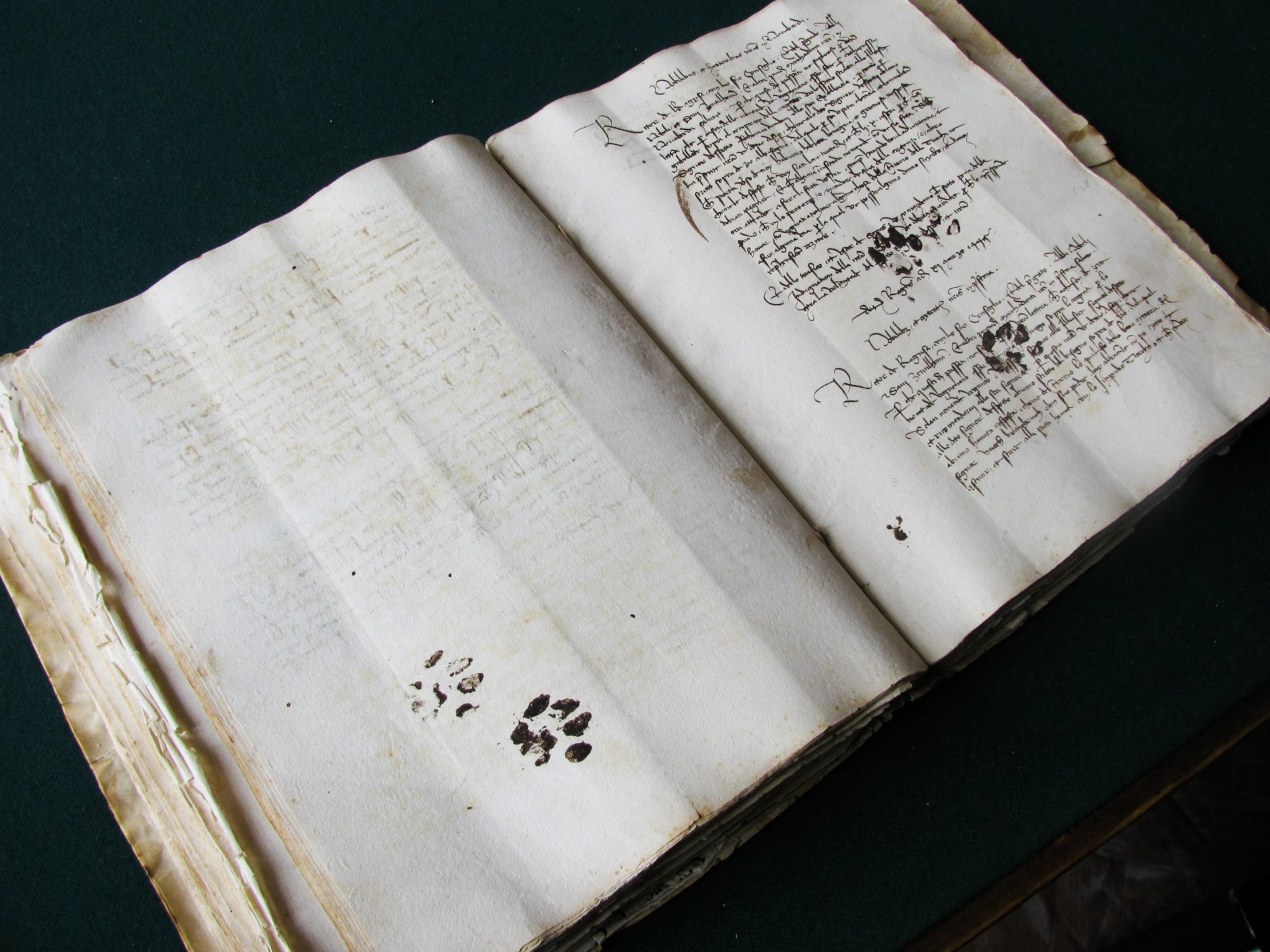
There are medieval manuscripts with paw prints on them where cats walked across the pages tracking ink.

Like this one. That’s sweet and infuriating at the same time, because OF COURSE a cat would do that.

I feel like people today think that the past was just all one big miserable mess, and sure there were dark parts, but people could be happy. I’m sure that they were. I’m sure that there were girls a thousand years ago who liked getting together with their friends and gossiping about the adults in town.

There’s a story about a pot that was dug up, which contained the remains of a dinner charred beyond saving. The owner had buried it in shame. That’s intensely relatable, huh?

I guess my point is just that humans have always been human and have always had weird little everyday things happen to them that we can relate to. Every so often I get with the sudden revelation that I’m doing something that my ancestors were doing a hundred years ago, whether its storytelling or sitting cocooned in like five blankets because it’s freezing or yelling at the clouds because they refuse to rain.

That’s a comforting thought, I think.

Writerly Things

I have been on another hiatus from this blog because school. It’s a pain in the butt. Anyway, I’ve spun the Wheel of Doom and today it landed on writing advice, so let’s get this dead horse on the road like a herd of fish.

Tip one: Mix metaphors. Screw with the traditional set up for your statements to give your audience a shock and liven things up.

Tip two: Don’t worry about your audience. Yes this directly conflicts with the previous statement. Don’t write for some nebulous future reader, write for you. Someone out there will relate to it.

I feel like I should be sitting reversed on a chair, arms perched on the back, drinking apple juice out of wine glass.

Tip three: Be specific, not general. Be as over the top specific as you can. Describe the weirdest parts of your characters daily routine or appearance. This will make them memorable.

Ex: “Martin was tall, with green eyes and messy, mouse brown hair.” vs. “Martin was tall, and shaped sort of a like a bear, if a bear had been made human by a witch who didn’t completely understand how humans worked.”

Which one sounds like it will stick with you?

Tip four: Obey the rule of threes. This will make your storytelling make sense.

My hope is that school will chill out a bit for the next few weeks and I’ll be able to just write blog posts in peace. Hope this is helpful and/or entertaining.

See ya around.

Percy Bysshe Shelley and The Tragedy of Idiocy.

Okay, so the title is a little bit of a misnomer, because I’m technically supposed to be doing poetry this entry, but I also had to share with you the greatest part of Percy Shelley’s life, which just so happens to be his death. I’ll make sure to put one of his poems at the end, though. And besides, the whole thing has a theme of poetry to it because he was a poet!

Okay, so Percy Shelley, husband of legendary authoress Mary Shelley, was a Romantic-era poet who ran in the same circles as John Keats and the like and was friends with Lord Byron, who was a whole other level of unhinged and annoying and whom I will have to return to later. (I hate Lord Byron with a burning passion that I am not wholly able to articulate but that he completely deserves.)

Anyway, Percy was a poet and also a First Class Dramatic Bastard, to the point that he PREDICTED HIS OWN DEATH. By drowning.

This man then proceeded to spend most of his free time going out on the water in little boats and absolutely outright refusing to learn how to swim. He was also a fairly inexperienced seaman. Why Mary Shelley married this man I do not know. But the point is, his prediction came true, entirely by his own hand, because he went out on the ocean off the coast of Italy and then disappeared.

A friend of his found a body washed up on the shore later and the only reason they were able to identify him was because of the 1820 volume of John Keats’ poetry he had in his pocket. They then had a funeral where they cremated him, but someone noticed that his heart was not burning due to some weird circumstances so they snatched it out of the fire and gave it to Mary to remember her husband by.

It probably partially calcified due to a combination of tuberculosis and water logging, or it didn’t (my mother thinks this is insane), but the point of the story is that he was an absolute madman and his wife the greatest goth to ever live. The goth details of Mary Shelley’s life will have to wait for another installment of what I think I’m going to make a series.

The thing is, 19th century artists of the scholarly type tended to be absolutely insane and there quite a lot of fascinating stories about them, so much so that I could probably write a book about it. They were all slightly unhinged and all knew each other, which led to some amazing anecdotes, so I think I might start a special series, and I’m going to name it 19th Century Shenanigans.

This will also allow me to finally write that rant about Lord Byron. He knows what he did.

But anyway, I’ll leave you with one of Percy Shelley’s poems, and one of my personal favorites: Ozymandias, a name which I’m pretty sure he pulled out of thin air.

Ozymandias

BY PERCY BYSSHE SHELLEY

I met a traveller from an antique land,

Who said—“Two vast and trunkless legs of stone

Stand in the desert. . . . Near them, on the sand,

Half sunk a shattered visage lies, whose frown,

And wrinkled lip, and sneer of cold command,

Tell that its sculptor well those passions read

Which yet survive, stamped on these lifeless things,

The hand that mocked them, and the heart that fed;

And on the pedestal, these words appear:

My name is Ozymandias, King of Kings;

Look on my Works, ye Mighty, and despair!

Nothing beside remains. Round the decay

Of that colossal Wreck, boundless and bare

The lone and level sands stretch far away.”
Another One Where I Show You a Painting

I’m ignoring the fact that I’ve been gone for a month and so should you because finals are ridiculous and who wants to work over Christmas anyway.

Because, quite simply, I want to talk about this:

Horrifying, isn’t it? I love this piece so much. I cannot stop thinking about it.

First, some context: this artwork depicts Vlad the Impaler, Voivode of Wallachia from 1448-1476, who made some absolute hell for the Ottoman Turks and is generally regarded as one of the most bloodthirsty madmen in history. He is also known as Vlad Dracula Tepes, and was the inspiration for Count Dracula. Yeah, that Dracula.

This man got his name by impaling people on stakes. While they were still alive. It was terrible and he killed a lot of people in the name of keeping the Ottoman Turks out of Europe.

However, in my travels around the internet, I have found that when Romanians discuss him, it is usually in good terms, as he is considered a good ruler. This is mostly because as long as he lived, he kept the Ottoman Turks from invading Wallachia.

This brings us around to the painting. I don’t know who the artist is, but the detail work is absolutely stunning. The very first thing that came into my mind when I saw this artwork was that it reminded me of the iconography of Christian Saints that was common in the medieval period.

In particular the placement of the hands and the almost-flat illustration style complete with lots of details were what caught my eye. The details are exquisite, precisely drawn, and the three panels are in perfect contrast. The bright fire of the right and left panels offset the light blue background of the middle and make Vlad, who is the central focus of this image, much more prominent.

He is instantly recognizable, and the added supernatural elements (wings, fangs, etc) seem to be perfectly in place. Additionally, I want to draw attention to the detailing on his clothes, because they are immaculate.

Anyway, that’s all, I just thought you all needed something unusual to add to your experience, so enjoy. I will see you next week, now that we are back to our regularly scheduled programming.

So I’m Not Sure You Know This

But theatre is an actual art form and takes the most insane levels of dedication to pull off. Hamilton straight up had to cut a hole in the stage to make the rotating platform they use. The lighting crew of the Lion King were given the task of making a wildebeest stampede look real. On stage. Without actual wildebeest. And not really a lot of puppets. Don’t even get me started on the chandelier in Phantom of the Opera.

And they did it. They actually pulled it off, and continue to do so, and make it look easy. This is basically an appreciation post for the technical side of theatre because yes, actors have a job to do and it’s very difficult, but the stage crew is back here moving mountains.

I have a huge amount of respect for anyone who chooses to work backstage on a theatre production of any kind, because it is a huge amount of work and responsibility, and it’s just wild that people can do it.

Also, a hand for the stage manager, who is sitting in the booth cuing every single thing happening onstage for upwards of two hours. It’s impressive, and I know for a fact that theatre wouldn’t work without them.

Also, the quick-change people, the make-up artists, the costume designer who has to figure out how to make a Rococo dress that allows its actress to breathe (Beauty and the Beast, for example), the techies trying who have to manually move lights risking their lives every night up in the rafters.

You are appreciated. We couldn’t do it without you. If it weren’t for you working your magic actors would just be standing in blank space and rags talking to air.

Here’s to the stage crews.

Snakes and Legacy

Recently, I’ve been working on a research project about the character of Medusa and her use in art, literature and life over time. It has been a long journey, but an insightful one, and since the spinner has chosen to discuss art today, I’m going to show you one of the most striking paintings I found.

Trigger warning: It’s a bit disturbing.

This is the Medusa painted by Michelangelo Merisi da Caravaggio in 1597, and one of the most visceral pieces of art I have ever seen. This painting has haunted my sleep for a while, since I started on the project.

It is painted on a round wooden shield –callback to Perseus’s mirror shield, most likely– covered in canvas, done with oil paints. There were two versions of this painting done, which were given to two different patrons. Caravaggio painted this to compete with Da Vinci (yes, that Da Vinci), who did a similar painting around the same time. However, we don’t have the later’s version, so we have no metric to judge who won this centuries-old competition. Caravaggio modeled for this himself, painting his own face in the mirror.

But look at the painting again. It’s shockingly life-like and far more grotesque than most of Medusa’s other portrayals. The only thing that comes close is the Perseus with the Head of Medusa statue created by Benevuento Cellini and that’s in bronze instead of red.

The twisted expression of shock and horror on Medusa’s face is something very real and human, reminding us that at the most basic level Perseus’s story is the story of a woman being mutilated by a man for no reason other than his own personal gratification.

The thing that many people miss about Medusa is that she did not ask for her death. She was not one of the myriad monsters that marauded around Greece, killing people and stirring up trouble. She lived on a remote island with her two immortal sisters and only turned to stone those who were foolish enough to disturb her. In short, Perseus invaded her home and killed her without cause.

Caravaggio’s painting is one of the few pieces of art that illustrates this situation truthfully, showing us Medusa’s last moments as she would have experienced them if this were not a myth. It is a very truthful painting, I think. It’s important to bring attention to artwork like this.

Sorry if that put a damper on your morning, but in light of recent events, I think it’s good to talk about things like this. Remember that there have always been monsters made by men, and that a lot of the time they don’t deserve that designation. And whoever you are out there, you aren’t alone. There are others like you.

I’ll see you all next week, hopefully with more fun subject material, but thanks for listening to me rant. Until next time.

Welcome to the Metaphorical Jungle

Time for writing advice, friends. Yep, it’s that time of the spinner-decided calendar when I share the tidbits of wisdom that have helped me most along the way, teasing them from my brain with a pair of tweezers like a hopefully-useful parasitic ear worm.

Too much? Probably. But note how that immediately conjured up a very vivid image for you. Therein lies the truth of the best writing advice I ever got.

Yes, everyone has heard “show, don’t tell,” at least once in their careers, but it’s a cliche for a reason, and that reason is that it’s important. Too much exposition without grounding description can ruin a story.
Don’t tell us about how the spice garden has been around for centuries, tended by a long line of hereditary keepers passing the responsibility from mother to child. Sure, that’s interesting, and if I was feeling generous, I’d keep reading to give it a chance, but it’s not quite enough to stick around for.

Instead, try describing the character’s childhood memories, her mother and grandmother teaching her to tend to the spices, the long tapestries on the walls, some faded with age, that show their family tree. Tell me about our main character’s life, memories, experiences, and interactions while she’s moving to keep my focus.

Extra tip: start where the action is. I don’t particularly care what your main character ate for breakfast unless they found a spider in their corn flakes. Start when the house catches fire, the police show up, the space worm attacks, or whatever it is you’re writing properly begins. If you’re writing a mystery, you could start with the murder. If horror, give your audience a little taste of what’s going to come later, or do a creepy prologue about how -insert thing here- came to be cursed/haunted/whatever.

So, there’s the post for this week. (Yes, I know I missed last week, there were extenuating circumstances). I’ll be back next Friday with more interesting creative things, and hopefully it will finally land on art so I can rant about the history of animation. Goodbye for now!

Time to Talk About Agatha

The entire internet is talking about Agatha Harkness and the Agatha All Along show, and I have a blog post to make while waiting for the next episode. Tis the time for music, so here, have both versions of the Ballad of the Witches’ Road, if you somehow haven’t come across them yet.

The sacred chant version, where you can hear Kathryn Hahn being way more talented at music than she has any right to be and Patti LuPone belting her head off just to flex on the rest of us. Love it, so glad this is coming out during spooky season.

And then here’s the version they did in episode four that is like the best jamming music in existence. Also Ali Ahn’s singing as Alice just killed me at the end of this.

And for good measure, here’s a cover from Annapantsu and the best remix on the internet.

I love Anna. Her vocal range is actually insane.

And then here is the remix the internet is screaming about.
Is this maybe too many version of the same song? Yeah. But I’m not doing a single thing about it. This is the most hyped I’ve been for a Marvel show since I joined the fandom four years ago, and I CANNOT WAIT for the rest of the episodes. I really don’t know how I’m going to make it to Wednesday.

But my thoughts are going to have to wait for the spinner to choose movies, which might be a while. I’ll see all you nerds next week!

October is Upon Us

Hello, ghouls, boys and in between, and welcome to the poetry jam. Yes, that is correct, today I will be sharing with you a bit of poetry. First off, I have to show you this:

Shivers. I’m always a fan of a good supernatural terror and admiration of female power. Also, have this, because I feel like it’s important.

Hallowe’en by A. F. Murray

(First appeared in Harper’s Weekly)

A gypsy flame is on the hearth,
Sign of this carnival of mirth.
Through the dun fields and from the glade
Flash merry folk in masquerade
It is the witching Hallowe’en.

Pale tapers glimmer in the sky,
The dead and dying leaves go by;
Dimly across the faded green
Strange shadows, stranger shades, are seen
It is the mystic Hallowe’en.

Soft gusts of love and memory
Beat at the heart reproachfully;
The lights that burn for those who die
Were flickering low, let them flare high
It is the haunting Hallowe’en.

And of course, Rule of Three and all, so one more for the road:

Falling 4 a ghost

There is a shadow,
A presence that shines
Candle smoke that lingers
Well past midnight,
A love by most forgotten
That will never die.
~ A. A. Roman

Well, that’s all for now, but keep an eye out because I’m currently watching Agatha All Along and I fully intend to rant about it. The only question is whether or not I’m going to wait for the season finale on October 30th. Goodbye for now!

Inaugural Post of the New Era (And Some Cool Music)

Hello, friends! Welcome to the new iteration of Grace’s Place, new, improved and ready to be even more of a menace than my fifteen year old self was.

A friend of mine recently alerted me to the existence of a genre of music I had never heard of before called phonk, which consists of various sub-genres all revolving around how much you can do with a baseline. I don’t know much about the genre’s history or its current politics, but what I do know is that it’s a vibe, and surprisingly good to have in the background while studying.

Specifically I’ve been introduced to a group called Molchat Doma, started in Belarus and currently existing in Los Angeles. Their songs are incomprehensible to me and sound like what would happen if Pattinson’s Batman had a Gothic architecture phase while living in an abandoned warehouse that got attacked by the personification of soviet brutalism, and it’s awesome.

https://molchatdoma.com

Here’s a link to their website, where there’s more information. Plus, the graphics over there are really cool. As for music recommendations, I would say try their first album, С крыш наших домов (yes, I know), which will come up if you just type in ‘Molchat Doma first album.’ If you like that, please do give the rest of their stuff a listen.

See you next week!